

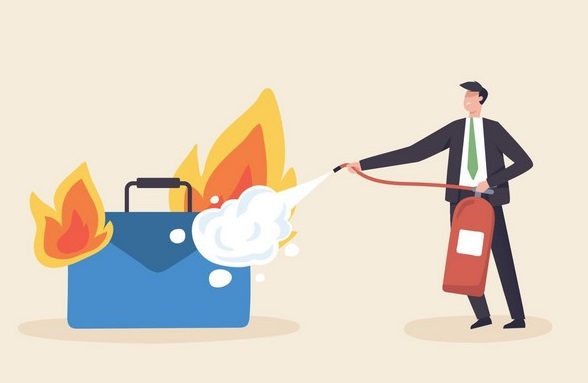
Even with hopes that the pandemic is over, managers, supervisors, and employees at all levels continue to report firefighting at a larger scale than ever before. By firefighting, I mean work that is reactionary, urgent—dealing with issues that are not what would be thought of as ordinary work. In fact, firefighting has become so prevalent, some organizations have difficulty separating the “ordinary, standard work” from the reactionary work. There are several contributing causes: the “Great Resignation” left us with fewer employees, resignations continue, skilled employees are hard to find, processes without PM are now running to failure, recruiting is more competitive, and newly hired employees (and newly promoted front line leaders) lack adequate technical and process knowledge.
How can your organization start making the shift away from firefighting toward more sustainable workloads and the work of ordinary business? Fortunately, the solutions for firefighting also provide the foundation to addressing the tide of resignations.
In a recent blog, I shared 4 steps to stop firefighting, based on McKinsey research related to engagement, retention, and resignations: caring leadership, sustainable workload, adequate pay, and development/advancement. This second blog in the series focuses on a sustainable workload.
Leaders Must Prioritize More Effectively:
Leaders at various levels of the organization need to take a hard look at processes and activities to make tough decisions that will allow for more manageable workloads. One of my current manufacturing clients has a team of managers, maintenance, and engineers whose lines represent more than half the throughput of the location. The team had more on their plates than they could handle, burnout was prevalent, and conflict was becoming more and more frequent. One simple activity alleviated the situation: they met as a team and prioritized every action item in their activity tracker—hundreds of items. This did not take as long as you’d think because the team used an effective discussion filtering technique that forced discussion where needed and allowed the team to skip over the places where they already had agreement.
Important note: doing this as a team was vitally important because members’ activities impacted the work of others on the team as well as the success of the overall team. Filtering techniques in discussion allow the team to move more quickly through the list than might be assumed. The common filtering technique discussed three separate questions related to each activity the member had committed to solving in earlier meetings: “what are the frequency, impact, and likelihood of the issue occurring again?” The result was a prioritization score for each item. Many items were eliminated from the list because they were so old, the issues had either gone way or had been superseded by something else. The items that remained were prioritized. Immediately, the symptoms of stress decreased and morale soared. The assumption became “no one could do it all.” As they did their work, they now knew which items to do in what order; plus, they could focus more on their standard work. The added bonus: the decision was made based on the priorities of the team.
Prioritization is a key to establishing and communicating a more realistic workload. In this case it was done as a team, which I recommend whenever possible. In other cases, a leader may elect to collaborate one on one with an employee to prioritize. In some cases, a leader may need to collaborate with other leaders or work independently to determine what work can be reduced or eliminated. Nearly every organization has redundant work. Creating a path forward to implement and sustain a realistic workload will help get a handle on employee churn and reduce firefighting.
Create a Plan to Transition to Standard Work:
Choose to deliberately create a plan to move away from firefighting. This may sound a bit ridiculous, and it will require fortitude. But consider the reality: in a state of firefighting, employees throughout the hierarchy make tradeoffs, many of which are not acceptable. Recently in one organization, one supervisor had been having urgent, separate discussions with various leaders in raw materials so that he could get better materials. Another supervisor was collaborating with scheduling to address an urgent yet ongoing manpower issue. A lead was “firefighting” related to automatically guided vehicles. Their motives were pure—all in an effort to keep the product going out the door. The costly downside? As long as they kept doing things in this way, the issues stayed hidden from the larger organization and from corporate leadership. Hidden issues cannot be solved. At the same time, standard work—everyday work that should be done—was not getting done. Lines were running, product was going out the door, but if this continued, the location would be forever consigned to firefighting.
To create a plan, determine which limited amount of firefighting is tolerable and what is not; and then hold people and processes accountable. Involving key stakeholders in this decision making is strongly advised. One location leader told his direct reports: “In prescribed cases (using well defined, measurable criteria), do not firefight. Let the downtime occur so that the problem can be escalated to the appropriate level for problem solving.” As stated above, this kind of an approach takes some fortitude and won the support of the location manager. The location needed resources, and covering up the issues was not working. Every effort for location or corporate resources needs a business case, so bringing opportunities for improvement to light is a key step.
Part of the organization’s plan must also include updated retention and recruitment practices. The workforce has changed, and if the organization’s recruiting processes look anything like they did three years ago, they desperately need to be revamped. Workers expect more engagement, more diversity, more flexibility, a more inclusive culture, and a clearer link to a meaningful organizational purpose. It’s still a “seller’s market” when it comes to hiring. However, considering a possible looming recession, a focus on developing and retaining current employees (and creating innovative intra-organizational mobility strategies) is vitally important.
As mentioned above, the steps for reducing firefighting are also the steps in developing a stronger organization when it comes to creating sustainable workload and retaining employees. For more discussion on this topic, please feel free to contact me or message me in LinkedIn.