

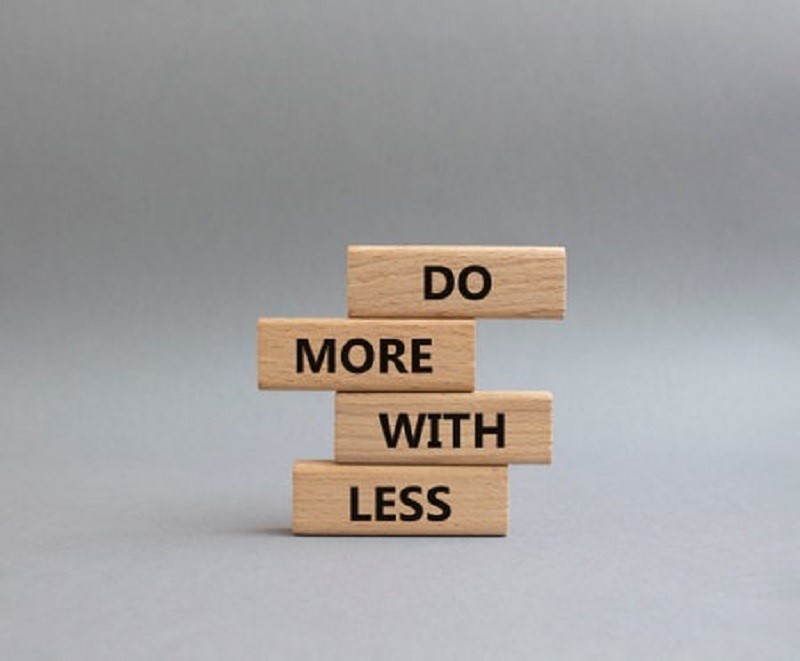
With recent layoffs, crushing inflation, and cost cutting across organizations, leaders at all levels of organizations are dealing with belt tightening. More and more they are being asked to do more with less. Easier said than done. Is that request realistic, or does it mean demanding more and more from employees—perhaps to the point of jeopardizing retention?
How can your organization truly do more with less, get the work done, meet goals–all while having sustainable workloads? It is possible, and there are four steps to follow to get there.
1. Assess the Current Situation
One of my current manufacturing clients has a team made up of managers, maintenance, and engineers whose lines represent more than half the throughput of the location. The team had more on their plates than they could handle, burnout was prevalent, and conflict was becoming more and more frequent. And then leadership directed them, “Figure out a way to do more with less.” The first step was to assess the current state. We evaluated current activities, tasks roles, and responsibilities. This step sets the stage for improvement; how can you close a gap if you don’t know where you’re starting?
2. Prioritize
Leaders at various levels of the organization need to take a hard look at goals, processes, activities, and tasks to make tough decisions that prioritize them and allow for manageable workloads. If leaders are trying to do more with less, then they can’t do everything. Once prioritized, tackling the planning and execution for “doing more with less” is more reasonable. Are there activities that can go away? Which ones, and in what order? Are there technologies that are redundant? Are there too many meetings? Are there workflows that can be streamlined, or processes that can be restructured? There is likely more room for improvement than you think. In one Pharma, we quadrupled the throughput of R&D in less than a year, with the same headcount. In a textile manufacturer, we tripled the size and production capability of a plant, all while keeping the same manager headcount. In both cases, leadership and planners questioned everything and weren’t afraid to be innovative. The priority was to do more with less, or to do much more with the same resources.
Once priorities are set by leadership at various levels in the hierarchy, the teams can then realign and re-prioritize areas in their purview based on those priorities. For example, in the example provided above with managers, maintenance, engineers, supervisors, and Continuous Improvement, one simple prioritization tool helped them realign quickly. They met as a team and prioritized every action item in their current activity tracker—hundreds of items. This did not take as long as you’d think because the team used an effective discussion filtering technique that forced discussion where needed and allowed the team to skip over the places where they already had agreement. The fact that new priorities had been set by leadership and communicated well by their Director made this process much quicker. Then, the manufacturing lines realigned their priorities as well.
3. Create a Plan
Involve employees. Just as involving employees in prioritization results in more realistic priorities, involving them in generating a realistic plan is essential. They have the most intimate understanding of current processes, and they have terrific ideas related to improving them. As planning cascades through the organization, teams or individuals will collaborate with their managers to design a specific plan for the area. Likewise, managers can collaborate one on one with employees as appropriate to create individualized plans.
Improve workflows or processes. Doing more with less assumes much greater efficiency. The plan will involve improving processes or workflows, eliminating voids, overlaps, and redundancies. The processes or workflows that need improvement were uncovered in the assessment and prioritization steps. Once the workflows become more streamlined, its time to develop Standard Work around those processes.
Design Standard Work. Workflows and processes dictated by leaner priorities will require employees to clearly understand how their roles may have changed and why and what they are supposed to be doing day by day. Standard Work helps ensure that what’s supposed to be done will get done. Defining standard work is identifying what things must be done daily, weekly, etc. to meet priorities and objectives. Standard work ideally should be identified for each level of the hierarchy. In client organizations, we often start with supervisors and leads, and then from there, spread across the hierarchy. Standard work, once identified, can be used as a daily guide for employees, helping them identify tasks and responsibilities for the day and helping them to move away from past activities. Use an electronic standard work form (a shared document) on which the employee can track whether each expected activity was done (and if not, why not). Don’t expect miracles overnight. In one client, once employees started applying their Standard Work, the organization identified and corrected other inefficiencies that were preventing the work from being done.
Coaching, Training and Accountability. Part of the planning should involve how employees will be trained and coached to “do more with less,” new priorities, and how they will be held accountable. Generally, these responsibilities fall on managers and supervisors and may require improvement of manager skill sets. This does not have to be complicated. One organization characteristically held Supervisor meetings and Lead meetings on a regular basis. To cover additional needed training, half of each meeting was now allocated for improving skill sets.
4. Implement
Once a plan is in place, implement it and track it accurately. Data can help you identify the need and make the argument for needed resources. Do not assume that implementation will be set in stone. Frequently, there are unforeseen obstacles in an organization’s processes and systems. Build in opportunities for mid-course corrections.
For a complimentary 60-minute strategy session or for more discussion on this topic, please feel free to contact me at [email protected] or message me in LinkedIn at https://www.linkedin.com/in/transformingorganizations/.