

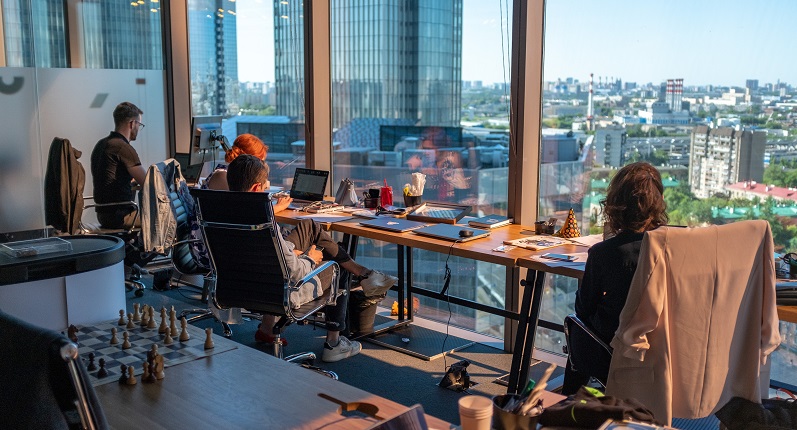
Over the past couple of months, I have been helping clients develop strategies and plans for the “Return to Work”(RTW) or “Return to Office” (RTO). Many employers want their employees to return to the office, believing the office environment is an integral part of their cultures. However, more than half of employees want to work from home three days per week, and recent research indicates that employers may very well lose those employees if they don’t provide flexible, hybrid work.
In a recent Fast Company article, Joseph Woodbury, CEO of Neighbor, makes an interesting case about hybrid work. He believes it will not work. He states that companies need innovation, energy, productivity, and what he refers to as a network effect, stating, “True human and employee flourishing occurs when the conditions and culture are put in place to create a strong physical community, where no one is left out. In 2021, we need less digital interaction and more human interaction. That’s what we’re building by embracing an in-office culture.” Read the article; it is compelling.
His point recalls a conversation I had with a client last week, the CEO of a pharmaceutical company. She also believes that hybrid will not work for her organization. She believes that hybrid may be an interim measure on the way back to a new normal for some organizations, especially as we deal with COVID variants, but she believes that it will not be sustainable for the long term.
With all the research pointing to mass resignations if organizations do not implement hybrid structures, is there a way to provide employees with flexible work that is not necessarily hybrid? Can we have the best of both worlds—flexible and in office? I believe it is possible if you’re willing to have a truly flexible organizational culture. I am not advocating in one direction or the other. (If you read my blogs, you know I help organizations implement hybrid structures.) Frankly, I believe you can make almost any strategy work with careful planning, attentiveness to employees and culture, feedback and accountability systems to support your plan, and a realistic eye to what is happening in the COVID world.
Some organizations are well known for their flexible work. And flexible is not necessarily Hybrid. For example, one client organization has no vacation policy and has not for years. This organization has strong recruiting processes, highly skilled and productive employees, and clear performance expectations and accountability processes. In its RTW plan, the company assumes that employees will be in the workplace to cultivate stronger innovation and to strengthen their high-energy culture. Employees regularly achieve or exceed their performance goals and meet their commitments to their teams, AND they have significant flexibility. Many of these employees have not historically come to the office 5 days per week; and although this type of schedule is a characteristic of hybrid organizations as well, this organization has no defined hybrid structure. Managers, employees, and teams coordinate to make flexibility work. When this organization’s employees return to the office, they will return to their status quo (not to a hybrid office), which was flexible to begin with.
In evaluating your organization’s RTO, are there opportunities for flexible work, even if all your employees return to the office? Or should you use Hybrid work as a step toward an eventual, complete return to the office, when and if the world goes back to normal? Or should Hybrid be your new normal?
If your organization has experienced recent turnover, now may be an ideal time to re-envision your new, truly flexible company culture. Whichever model of work your organization embraces, there are key aspects that can need to be part of the transition:
- Let employees know your strategy and guidelines for the RTW well before you expect them to return. The more detail, the better.
- It’s a good idea to transition employees into the return, helping to ease the transition. If you plan a complete RTO, I believe easing in with hybrid is a good idea.
- Since employees have been away from the office for a long time and there may have been turnover, and managers may not have managed their teams as well as would have been ideal, a Harvard Business Review article recommends a great idea–we should onboard employees again, even the ones that have been with us for years.
- Communicate to employees that the return to work is a work in progress and changes will be likely to occur–not only due to business needs, but also due to the evolution of COVID variants. Communicate that we are all in new territory; we have never been in this situation before. Most likely, mid-course corrections will be required from time to time.
For help with your Return to Work plan, or strategy-culture realignment, please contact us for a complimentary review of you plan or for a 60-minute strategy session. You may set a meeting, email me and follow or message me in LinkedIn.
Leave a Reply